
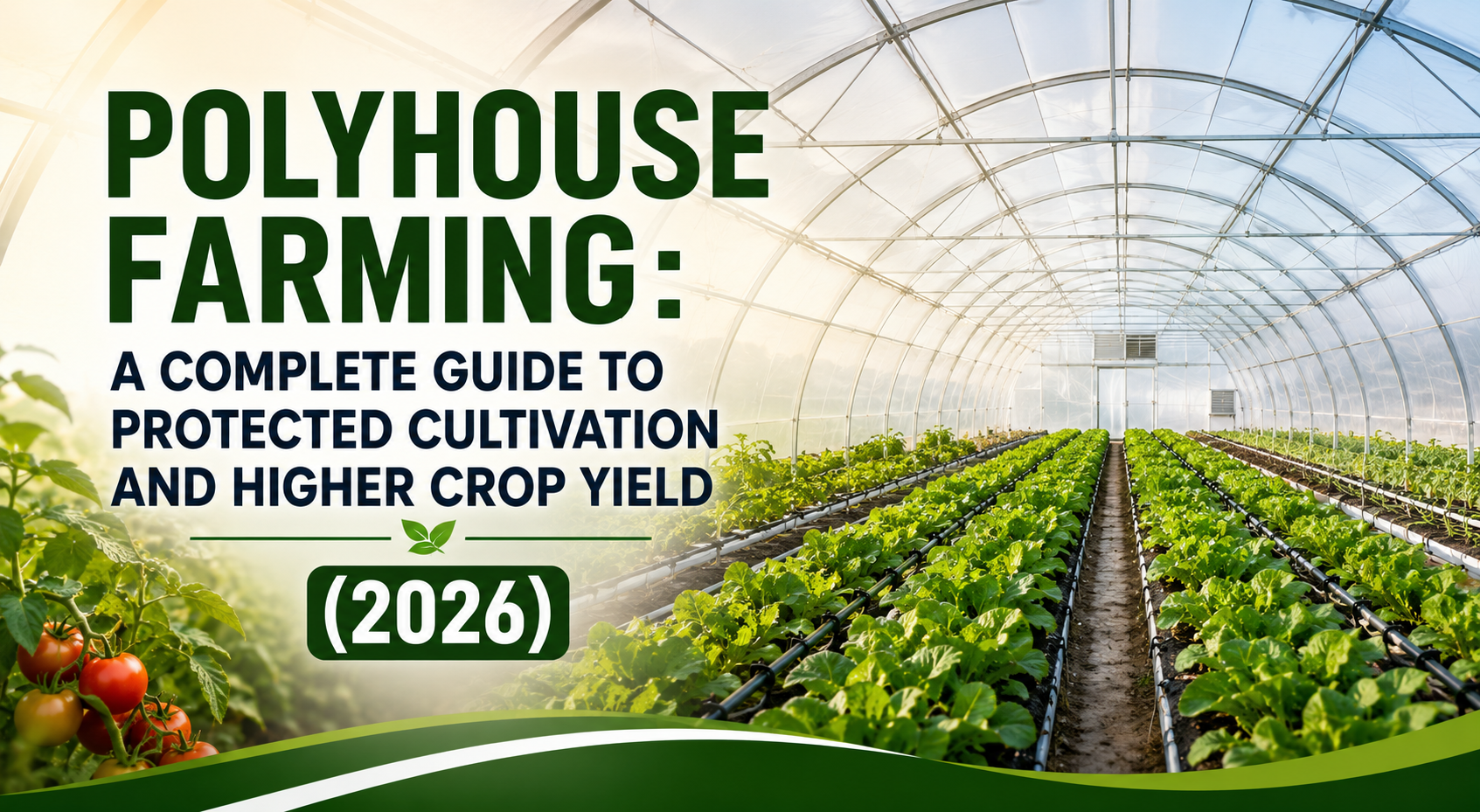
Polyhouse Farming: A Complete Guide to Protected Cultivation and Higher Crop Yield (2026)
Introduction
Modern agriculture is changing rapidly as farmers look for better ways to increase production while protecting crops from unpredictable weather. Heavy rainfall, extreme heat, pests, and diseases can reduce crop quality and affect farm income. To overcome these challenges, many farmers are adopting Polyhouse Farming as a reliable cultivation method.
Polyhouse Farming is a protected cultivation technique that allows crops to grow in a controlled environment. By managing temperature, humidity, light, and irrigation, farmers can produce healthy crops throughout the year. This method improves productivity, reduces crop losses, and supports sustainable agriculture.
Whether you grow vegetables, flowers, fruits, or high-value crops, Polyhouse Farming offers an efficient solution for increasing yield and improving farm profitability.
Quick Answer
Polyhouse Farming is a protected cultivation system where crops are grown inside a specially designed structure covered with transparent plastic sheets. It creates a controlled environment that improves crop growth, increases yield, saves water, and protects plants from harsh weather conditions.
What Is Polyhouse Farming?
Polyhouse Farming is an advanced agricultural practice in which crops are cultivated inside a structure made of galvanized steel and covered with UV-stabilized polyethylene sheets.
The controlled environment protects crops from excessive rainfall, strong winds, frost, insects, and temperature fluctuations. Farmers can regulate temperature, humidity, ventilation, and irrigation according to crop requirements, resulting in healthier plants and better-quality produce.
Why Is Polyhouse Farming Important?
Changing climate conditions have made crop production more challenging. Unpredictable weather often affects crop growth and reduces productivity.
Polyhouse Farming helps farmers overcome these challenges by providing a stable growing environment. It allows year-round cultivation, improves water-use efficiency, reduces pest attacks, and supports the production of high-quality crops that meet market demand.
Benefits of Polyhouse Farming
Polyhouse Farming offers several advantages for farmers. It increases crop yield by providing favorable growing conditions throughout the year. Better environmental control improves plant health, fruit quality, and overall productivity.
The system also reduces water consumption when combined with drip irrigation and fertigation. Since crops remain protected from heavy rain, wind, and many pests, farmers often experience lower crop losses and better returns on investment.
Another major benefit is the ability to grow off-season crops, allowing farmers to earn higher prices when market supply is limited.
Crops Suitable for Polyhouse Farming
Many high-value crops perform well under protected cultivation. Vegetables such as tomatoes, capsicum, cucumber, and lettuce are commonly grown in polyhouses.
Flower crops including roses, gerberas, carnations, and orchids also benefit from controlled environmental conditions. Fruits like strawberries and some exotic crops can also be successfully cultivated depending on local climate and market demand.
How Does Polyhouse Farming Work?
A polyhouse creates a controlled microclimate for crop production. Transparent plastic sheets allow sunlight to enter while protecting crops from unfavorable weather.
Temperature, humidity, ventilation, irrigation, and nutrient supply are managed according to crop requirements. Many modern polyhouses also use drip irrigation, fertigation, shade nets, cooling systems, and automated climate controls to maximize productivity.
Types of Polyhouse Structures
Polyhouses are available in different designs depending on climate and investment capacity. Naturally ventilated polyhouses use side and roof ventilation for air circulation and are suitable for many regions.
Climate-controlled polyhouses use cooling pads, exhaust fans, fogging systems, and automated controls to maintain ideal growing conditions. These structures are generally used for commercial cultivation of high-value crops.
Common Mistakes to Avoid
Poor site selection, improper ventilation, low-quality covering materials, and incorrect irrigation management can reduce crop performance.
Farmers should regularly inspect the structure, maintain irrigation systems, monitor temperature and humidity, and follow recommended nutrient management practices for the best results.
Frequently Asked Questions (FAQs)
Q1. What is Polyhouse Farming?
Polyhouse Farming is a protected cultivation method where crops are grown inside a controlled environment covered with transparent plastic sheets.
Q2. Which crops are suitable for Polyhouse Farming?
Vegetables, flowers, strawberries, herbs, and many high-value horticultural crops are suitable for polyhouse cultivation.
Q3. Does Polyhouse Farming save water?
Yes. Polyhouse cultivation usually uses drip irrigation, which significantly reduces water consumption while improving irrigation efficiency.
Q4. Is Polyhouse Farming profitable?
Yes. With proper crop selection and management, polyhouse cultivation can increase yield, improve crop quality, and generate higher income.
Q5. Can small farmers adopt Polyhouse Farming?
Yes. Small, medium, and large farmers can adopt polyhouse cultivation depending on available land, budget, and crop requirements.
Conclusion
Polyhouse Farming is becoming an important solution for modern agriculture. It helps farmers protect crops, improve productivity, conserve water, and produce high-quality vegetables, flowers, and fruits throughout the year.
By adopting protected cultivation techniques, farmers can reduce production risks, increase profitability, and build a more sustainable farming future.
Ready to Start Protected Cultivation?
Looking to improve crop quality and maximise farm productivity? PPD Agrotech offers reliable Protected Cultivation solutions to help farmers adopt modern Polyhouse Farming, efficient irrigation systems, and advanced agricultural technologies for sustainable growth. As Smart Farming Experts, we provide innovative agricultural solutions tailored to your farming needs. Contact PPD Agrotech today to find the right solution for your farm.