
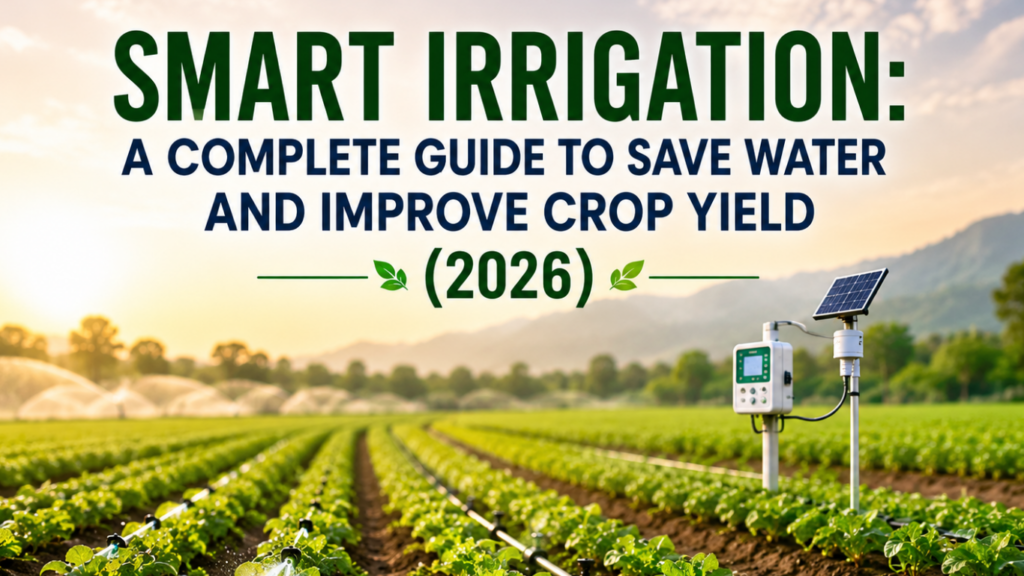
Smart Irrigation: A Complete Guide to Save Water and Improve Crop Yield (2026)
Introduction
Water is one of the most valuable resources in agriculture. Traditional irrigation methods often waste water and do not always provide crops with the right amount of moisture. As a result, farmers may face lower yields, higher production costs, and reduced farming efficiency.
Smart Irrigation is a modern irrigation approach that uses technology to deliver water according to the actual needs of crops and soil. By using moisture sensors, weather data, and automated systems, Smart Irrigation helps farmers conserve water, improve crop health, and increase agricultural productivity.
Whether you own a small farm or manage large agricultural land, adopting this advanced irrigation method can improve water efficiency and support long-term sustainable farming.
Quick Answer
Smart Irrigation is an advanced irrigation system that uses sensors, weather information, and automation to supply the right amount of water at the right time. It helps save water, improve crop growth, reduce irrigation costs, and increase farm productivity.
What Is Smart Irrigation?
Smart Irrigation is a technology-based irrigation method that automatically controls water application according to soil moisture, weather conditions, and crop requirements.
Unlike traditional irrigation schedules, this system provides water only when crops actually need it. This improves water efficiency while preventing overwatering and underwatering.
Farmers can also monitor and control many irrigation systems remotely using smartphones or computers, making irrigation management easier and more efficient.
Why Is Smart Irrigation Important?
Water scarcity has become one of the biggest challenges in modern agriculture. Efficient irrigation is essential for maintaining healthy crops while conserving natural resources.
Smart Irrigation helps farmers optimize water use, improve fertilizer efficiency, reduce energy consumption, and support sustainable farming. It also minimizes water loss caused by evaporation, runoff, and excessive irrigation.
Benefits of Smart Irrigation
Using Smart Irrigation offers several advantages for farmers. It reduces water wastage by supplying water only where and when it is needed. Better moisture management promotes stronger root development, healthier plants, and higher crop yields.
This irrigation method also lowers electricity and pumping costs because irrigation systems operate only when required. Automated scheduling reduces manual labor and saves valuable farming time.
Another important benefit is environmental protection. Efficient water management helps reduce soil erosion, nutrient loss, and groundwater depletion while supporting sustainable agriculture.
How Does Smart Irrigation Work?
A Smart Irrigation system collects information from soil moisture sensors, weather stations, and irrigation controllers. The system analyzes this data and decides when irrigation is required.
When soil moisture falls below the required level, the irrigation system automatically starts watering. Once the desired moisture level is reached, watering stops automatically. This process ensures crops receive adequate water without unnecessary waste.
Types of Smart Irrigation Systems
Several irrigation systems are available depending on crop type and farm size. Drip irrigation delivers water directly to plant roots, reducing evaporation losses. Sprinkler irrigation distributes water evenly across the field and is suitable for many crops.
Sensor-based irrigation adjusts watering according to real-time soil moisture, while weather-based irrigation controllers use local weather forecasts to optimize irrigation schedules.
Selecting the right irrigation system depends on soil type, climate, crop requirements, and available water resources.
Common Mistakes to Avoid
Many farmers invest in advanced irrigation equipment but fail to maintain sensors or monitor system performance regularly. Poor sensor placement, incorrect scheduling, and lack of maintenance can reduce irrigation efficiency.
Regular inspection, proper installation, and routine maintenance help ensure reliable performance and maximize the benefits of automated irrigation systems.
Frequently Asked Questions (FAQs)
Q1. What is Smart Irrigation?
Smart Irrigation is an automated irrigation system that supplies water according to soil moisture, weather conditions, and crop requirements.
Q2. How does Smart Irrigation save water?
It provides water only when crops need it, reducing overwatering, runoff, and evaporation losses.
Q3. Is Smart Irrigation suitable for small farms?
Yes. It can be used on both small and large farms to improve water efficiency and crop productivity.
Q4. Which crops benefit from this irrigation system?
Vegetables, fruits, cereals, pulses, orchards, flowers, and greenhouse crops can all benefit from efficient irrigation management.
Q5. Can Smart Irrigation increase crop yield?
Yes. Proper water management improves plant growth, nutrient absorption, and overall crop productivity.
Conclusion
Smart Irrigation is helping farmers improve water efficiency while increasing crop productivity. By combining automation, soil moisture monitoring, and weather-based irrigation scheduling, farmers can reduce water consumption, lower production costs, and achieve sustainable agricultural growth.
Adopting modern irrigation technology today can help build a more productive, profitable, and environmentally responsible farming future.
Ready to Improve Water Management?
Efficient irrigation is essential for healthy crops and better harvests. PPD Agrotech offers reliable Agricultural Solutions to help farmers adopt advanced irrigation technologies, improve water management, increase productivity, and achieve sustainable farming success. Contact PPD Agrotech today to find the right irrigation solution for your farm.